Showing posts with label zeuhl. Show all posts

Friday, 7 April 2017

Universal Totem Orchestra - Mathematical Mother (2016)


The long awaited third album by UTO and well worth the wait too. Another stellar album by this zeuhl influenced band with much more female vocals than the previous albums' which is not in the least dissapointing in my opinion and very welcome, although some may disagree. There's some unusual style changes in here too with some of the ethnic and folk elements. A brilliant album....don't miss it!!!!!!

This is the third offering from Universal Totem Orchestra, a quixotic Italian band that gets criticized for not being pure zeuhl (nothing is really, besides Magma) and thus dividing Progland into outright fans and naysaying purists. Too bad really, as they never claimed to be devoted followers in the first place. Their debut "Rituale Alieno" as well the follow up "The Magus" are both, in my humble opinion, extraordinarily brilliant albums that deserve the loftiest progressive praise. There are some similarities with Magma and some huge differences. First the common elements, namely a furiously talented leader in drummer UTO G. Golin who simply pounds and sizzles throughout all their tracks, pushed along by the reptilian bass of Yanik Lorenzo Andreatta. Definitely near Vander/Top/Paga levels of quality. The arrangements hover from bombastic Wagnerian explosions to jazzier climes, again a Kobaian characteristic. The major difference is Ana Torres Fraile's booming voice that is beyond description, capable of a wide variety of tones, octaves and styles, but much closer to opera than anything else. Occasional forays into Arabic, Gothic and Gregorian leanings only accentuate her stunning brilliance. She is also extremely attractive. Furthermore, guitarist Daniele Valle and keyboardist Fabrizio Mattuzzi can hold their own with the very best the prog universe can suggest, technically hyper-proficient but loaded with gusto, bravado and oomph. Finally, saxophonist Antonio Fedeli adds the sultry instrument at the most appropriate of times, such as one the shining and eloquent "Architettura Dell'Acqua". UTO's style is way more expansive, playful, symphonic, jazzy, retro, bucolic and medieval than anything unleashed by the Destruktiw Kommandohs.

Kick off the Mathematical Mother opus with a 14 minute surge "Terra Cava", a whirlwind demonstration of the various talents at hand, a scat singing opener that quickly evolves into a complex and insistent polyrhythmic explosion with zooming bass, deft stick work, cool piano musings and a hard carving guitar rampage. Fraile's voice seduces immediately, her lung capacity is quite impressive to say the least, extended long series of notes and trembling invocations, a truly impressive diva. The ornamental piano takes over a great deal of the melodic arrangement, sumptuous and elegant as it should be, deepening the reflective emotions and enriching the pace. At the 8 minute mark, the rabidly intense bass guitar rumbles through like a freight train, the dynamic mood turning Saharan and the spirit utterly adventurous. The bass tone is trebly and extremely fluid, a sort of Squire/Entwhistle synthesis that will astound the fans of the mythical instrument. Guitarist Valle then goes on his flowery rant, egging Mattuzzi to take over and rise to the heavens. I find myself slammed right between the eyes by the sheer power of their demanding and virtuous music.

A blistering fury is set with the exalting "Codice Y16", a synth-blasted shorter piece that seeks to underline a kind of a Charlie Brown?like piano motif (you will get it when you hear it), a perfect platform for Mattuzzi's wild synthesizers to parallel Fraile's thrilling and athletic voice. The jazz elements are straight forward here, almost Canterbury-esque in many ways, again muscled along by that impulsion -fueled bass guitar, a joy to follow throughout this splendid disc.

The ebb and flow on "Elogio del Dubbio" will make your head spin, from misty serene to ethereal Gothic as well as out right bull in a china shop, the whole thing just spirals mightily into the celestial heavens. A blizzard of persevering notes, played at breakneck speed, then suddenly, an eerily Dead Can Dance like Arabic lamentation swoops in from the desert, assisted by some cool tablas , meandering into the labyrinths of the mind. Fraile wailing majestically once again, the scimitar-edged pace heightens as the ravaging guitar slashes mightily through the haze. Praise be to the Golin School of drumming, the man is a total beast.

The compelling "Architettura Dell'Acqua" is the masterpiece on this album, a simply incredible piece of music, incorporating the mellifluous soprano voice, lyrics in English and the sophisticated saxophone , unified in an idyllic initial setting, lush with heartbreaking fragility and purest design. Then the alternating themes begin their madcap ballet, the echoing piano treatment giving rise to some furious guitar pirouettes, as well as some dazzling turbo- charged flurries from the band, swift and adventurous. Back to the momentary calm before heading back to the fury. Tons of little details abound, like the squeaky synth wobbles, the heavy rock guitar showcase, the choir additions giving this a Orff-ian bombast that is hard to resist.

Back to jazzier horizons on "Citta Infinite", another perfect platform for Ana Torres Fraile to shine, a mesmerizing vocal display. This is semi-mellow stuff but it does include a snippet from UTO's masterful epic "De Astrologia" off the Magus album, which remains in my humble opinion, a classic prog tour de force. The vibraphone solo from Mirko Pedrotti is eyebrow raising to say the least. Wow! The final track "Mare Verticale" borrows again the disorienting and pounding rhythmic style that is their claim to fame, aided by a devilish bass and drum assault and adorned by some technically astute voice work that never ceases to amaze. I can listen to this a thousand times and still be impressed by the brilliant playing and the technical savvy by each band member.

In recap, this is an album that one can listen to as a whole, then go through it again just listening to one instrument, one at a time. That for me is the inherent attraction of any prog album. To the 19% who labelled this poor and only for completionists , you have my deepest condolences.

5 Measured mammas

Songs / Tracks Listing

1. Terra Cava (14:06)
2. Codice Y16 (5:21)
3. Elogio Del Dubbio (7:54)
4. Architettura Dell'Acqua (11:27)
5. Città Infinite (6:19)
6. Mare Verticale (7:38)

Total Time 52:56

Line-up / Musicians

- Ana Torres Fraile / vocals
- Antonio Fedeli / alto and tenor saxophone
- Daniele Valle / guitar
- Fabrzio Mattuzzi / keyboard, piano
- UTO G. Golin / drums
- Yanik Lorenzo Andreatta / bass


Wednesday, 6 January 2016

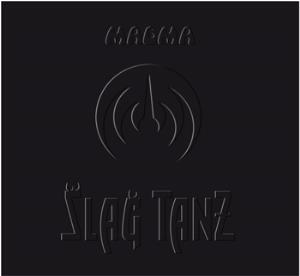
Magma - SLAǧ TANƶ (2015)


To my ears one of the best, if not the best of Magma ( Christian Vander) albums.This  has all the Zeuhlistic trademarks - pulsating bass, massed vocal dexterity,intricate and powerfull drumwork, which reaches those frenzied heights only this band know how to do, and all melded together as one whole, which demands to be heard from start to finish. I love the shamanistic ritual vocal touches which is quite new with this band. Check out the awesome live video below!

 A MUST HAVE for any any MAGMA fan! Only complaint is , i wished it were longer!!
SC&ME 

There are several things that set this album apart from other Magma albums that I have heard. First and foremost is the amazing cymbal play of drummer extraordinaire, Christian Vander. Second is the way in which Magma have refined and mastered their delivery format for their stories from the world of Kobaia. And third is the way in which the long-time band members have mastered and refined their vocal instruments: Stella Vander, Isabelle Feuillebois and Herv' Aknin (and even Klaus Blasquiz, who does not appear on this album) are simply astounding. They are solid as rocks. They are so seasoned that it is hard to discern any flaws in their work. It must be so nice for band leader, Christian Vander, to have such companion/collaborators who seem so unwavering in their support and who are so dedicated to this form of music, to the vision of their band leader, as well as to the betterment of their own skills. While I have to admit that I find Slag Tanz slightly less engaging than Magma's previous recent studio releases, however, I find it hard to rate any modern recording of Magma's with anything less than five stars because the composition, performances, and recording/engineering is so consistently strong (even though many of the compositions were composed decades ago and have been performed live for years). It is my strong opinion that we music listeners are so very privileged to have the recordings and concert performances of an artist with such strong and independent vision who always composes and performs at the absolute highest levels every time (and, of course, demands the same of his collaborators). 


This might be the single greatest piece of music that i've heard from MAGMA. According to Christian Vander it was written back in the seventies and played live in different forms since 2009. I'm such a big fan of not only dark and intense music like we have here but especially when contrasted with mellower passages. Now these more laid back sections often have this burning undercurrent to them but they also that lighter sound with female vocals at times. This is a 21 minute piece of seamless music divided into eight parts.
"Imehntosz-Alerte!" features Fender Rhodes, cymbals and bass early on as male vocals kick in. It settles back into a dark atmosphere as the male vocals return. Some tension here for sure as it blends into "Slag". The bass and vocals really impress here as it becomes fuller right away. It's picking up in tempo and in intensity a minute in. So good! Check out the insane vocals before 1 1/2 minutes as well as the killer drum work. It settles right down before 2 minutes as Fender Rhodes, drums, bass and female vocals lead the way. The insanity is back after 2 1/2 minutes but then it settles and blends into "Dumb" where female vocals and male vocals lead the way. They are burning it up with male vocals once again around a minute and check out the female vocal melodies that follow. Contrasts continue then a calm follows as bass and drums take the spotlight. It turns extreme again.
"Vers La Nuit" is led by female vocal melodies, bass and drums then the male vocals arrive as they trade off before both join in together as it turns fierce late. "Dumblae-Le Silence Des Mondes" settles to start with male vocals before it builds with male and female vocals. Check it out at 2 1/2 minutes! That female voice that cries out and the bass in that doom-like atmosphere. Incredible! "Zu Zain!" sounds amazing with the bass from Bussonnet that is just grooving and Vander's random drum patterns. Female vocals arrive around 1 1/2 minutes. "Slag Tanz" is beyond profound in my world with those intense vocals along with the Fender Rhodes, bass and drums. Simply killer! It settles late and it feels right that this EP should end here but then we get "Wohl Dunt" which is almost dirge-like with piano and Christian's slow vocals as it gives us a chance to figure out what the hell just happened.
I wasn't that impressed with the previous EP by MAGMA but man they have blown me away with this one.

Alright, here's the one all the Magma fans have been waiting for for quite some time now, and the question is, has the wait been justified? They've been playing this piece live since around 2009, and it has slowly morphed into the piece it is today. Bits have been chopped off, bits have been added, and does it work? Well for me, the answer to that is a resounding "yes". On my initial hearing, I didn't quite know what to make of it. It was certainly different than the live versions I had heard, it seemed to be lacking the sheer metal brutality of its live predecessor on Epok V, and I took this to be a weakness. Yet, there was still something in there that brought me back to it. After many listens, my ears have definitely warmed up to the sound of it, it is definitely less raw and metallic than the live version, but it is just as effective. This piece is very dense and episodic, alternating flawlessly between dark and heavy to angelic beauty. In other words, the piece is constantly moving itself forward, there is very little downtime; boring is the last word one could use to describe it. What it may lack in brutality, it makes up for with intensity and power. What I find most striking about this piece is its genius use of it's main, pulsating 5/4 bass riff (sort of like De Futura). The riff is present throughout nearly the entire piece, and yet it morphs to fit the mood of whichever section of the piece it's in. This riff lies under both heavy, dark passages as well as the light, melodic ones, and I believe this is where the genius of this piece lies; the ability to take this single riff, and flesh it out into a beautiful and powerful 20 minute piece. This is the very definition of fully fleshing out a single idea. Yes, I did say only 20 minutes, but the quality totally exceeds the quanitity. Vander's been working on this piece for years, he wouldn't release it as an unfinished work, he doesn't seem to be the one to take short cuts. Highly recommended.  Reviews from Progarchives.com

 Songs / Tracks Listing
 
1. Imëhntösz - Alerte ! (2:19)
2. Slag (3:03)
3. Dümb (2:57)
4. Vers la nuit (3:30)
5. Dümblaë - Le silence des mondes (2:58)
6. Zü Zaïn ! (2:16)
7. Slaǧ Tanƶ (2:29)
8. Wohldünt (1:23)

Total Time: 20:55

Line-up / Musicians
 
- Stella Vander / vocals
- Isabelle Feuillebois / vocals
- Hervé Aknin / vocals
- Benoit Alziary / vibraphone
- James Mac Gaw / guitar
- Jérémie Ternoy / piano, Fender Rhodes
- Philippe Bussonnet / bass guitar
- Christian Vander / drums, piano, vocals 


Sunday, 3 January 2016

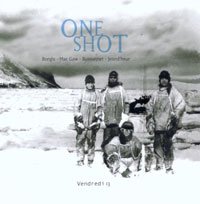
One Shot - Vendredi 13 (2001)


First rate zeuhl music for all Magma fans. All of there releases are well worth checking out if you can find them!
SC&ME

Get in line, put down your money and get yer Zeuhl fix right here. Satisfaction guaranteed.
One Shot, featuring Emmanuel Boghi, keyboards, James Mac Graw, gujitar, and Philippe Bussonnet, bass, all members of the 90s Magma line-up, plus drummer Daniel Jeand’heur, churn out instrumental Magmoidisms that will excite and give great satisfaction to all those who love the legendary French group which spawned Zeuhl music.
The music derives from Magma’s Udu Wudu period with all of the requisite sounds, style, gestures and more. The opening track features the band riffing on motifs which are inspired by “Zombies.” Borghi favors the Fender Rhodes electric piano with fat, juicy and weird harmonies, nervous figuration and erratic rhythms. The heavy vibrato and upper register synthesizer of “Blue Bug” is reminiscent of the Moog line at scattered throughout “Troller Tanz.” Bussonnet has captured the sound and spirit of Jannick Top and Bernard Paganotti. His work is spotlighted throughout in “No.” While it does not focus on virtuoso technique, Bussonnet showcases are more trebly and brittle sound than that of either Top or Paganotti, though when he rips into his instruments, he elicits that famous and devastating buzzing sound that is the calling card of Magmoid bassists. “In a Wild Way” features a tasty bass part that features little strummed chords, as if played on rhythm guitar, and a wah-wah pedal, breaking a bit from tradition. Also, the tune breaks into a straight ahead jazz fusion passage and even moves into a funk groove, but one with that wonderfully weird Zeuhl component.
Additionally, while Magma only occasionally included guitarists, Mac Graw’s guitar is in keeping the style and specter of those few guitarists; think of the guitar workby Gabriel Federow on Magma’s live albums. He is a remarkable virtuoso and often playing front and center. While Jeand’heur does not quite imitate Vander’s sound and style, his playing fits in perfectly, full of fire and explosive power.
The kicker is that this is a live recording and One Shot proves to be one tight and overpowering group. Stunning!

Dean SUZUKI (Expose – Issue 23 – December 2001)

Thursday, 21 May 2015

Magma - Riah Sahiltaahk (2014)


RÏAH SAHÏLTAAHK is listed by most sources as a new studio album by MAGMA but it is in fact simply a re-recording of the first track of the same name from their second album "1001 Degrees Centigrades" which came out all the way back in 1971. This album clocks in at a mere 24:24 so no matter what it "officially" is, this is a freakin' EP in my book. This is one of those projects that makes you scratch your head and wonder why such a thing was necessary. To the casual listener there seems to be few differences between the two but a more careful inspection and repeated listens does yield some substantial changes. Just check out the lineup between the 1971 version and the newest of 2014.
1971 verison
- Christian VANDER : vocals, drums, percussion - Klaus BLASQUIZ : vocals, percussion - François CAHEN : acoustic & electric pianos - Francis MOZE : bass - Teddy LASRY : clarinet, sax, flute, voice - Jeff SEFFER : sax, bass clarinet - Louis TOESCA : trumpet
2014 version
Stella VANDER : vocals Isabelle FEUILLEBOIS : vocals Hervé AKNIN : vocals Benoît ALZIARY : vibraphone James MAC GAW : guitar Jérémie TERNOY : piano Philippe BUSSONNET : bass Christian VANDER : drums, vocals, piano
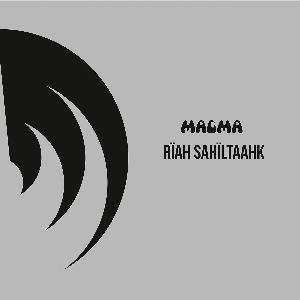
On the newer version basically we get no horns, more female vocals and a vibraphone. Also the production is quite different as well. The music is one continuous track on the original but only clocks in at 21:45 so a few minutes shorter. On the newer version we we get eight separate tracks that constitute the movements. The artwork is remnant of the original album as well only instead of duct tape grey it is a glimmering silver with the MAGMA emblem wrapped around the front and back instead of boldly displayed in full on the front.
This is story on the Seventh Records website: RÏAH SAHÏLTAAHK is the name of the Kobaïan who left after all the others, despite their disapproval. He thought he was better than anyone else and he was sure he could convert Kobaïa's enemies to the Kobaïan spirit. But he failed and left alone for Kobaïa. On the symbolic stop-over planet, Malaria, he has to face the raging elements he thinks he can dominate. With his ship almost sunk, he ends up begging them - to no avail. He will disappear. Drowned, swept away by the frenzied elements. After the noise? silence. At dawn, only a finally calmed remains, enlightened by the soft beams of the sun in this new day.
Honestly, I can't say I really like one thing better than the original. The first thing you notice on the new version is that the tempo is just a bit slower and the production is amped up which seems too beefy for some reason. The original version seemed to have more spontaneity and improvisation in the zaniness department. Absent are the blood-curdling screams and high pitched freakouts during frenzied time-outs from the main scheme of things. I actually really love the horn sections of the first two MAGMA albums and find that here Vander sounds like he is trying to MDK his earlier works. This just seems unnecessary to me as a fan, but as a man Christian Vander who has obviously been pining over re-releasing this for sometime just had to bring it to fruition. Now that he has I am dumbfounded by his decision to carry through when, to me at least, the original is the superior. I categorize this as indulgently unnecessary so I cannot give this the same five star rating that I gave the "1001 Degrees Centigrades" album, however this music even if inferior to the original is still completely enchanting and simply MAGMA-nanimous so to give it less than four stars would simply be a crime against humanity. I just hope this isn't the beginning of a trend to repackage the entire back catalog when MAGMA proves time and time again that as a musical outfit it is quite capable of releasing fresh and relevant music in the 21st century.Review from Progarchives.com

Songs / Tracks Listing
 
1. Watseï kobaïa (4:40)
2. Di mahntër sahïltaahk (3:00)
3. Süri sï toïdo (3:31)
4. Ün zoïn glaö (3:10)
5. Ïss walomëhn dôm (2:25)
6. Bradïa ëtnah (2:24)
7. Môm loïlë (3:45)
8. Woleï (1:29)

Total Time: 24:24

Line-up / Musicians
 
- Stella Vander / voice
- Isabelle Feuillebois / voice
- Hervé Aknin / voice
- Benoît Alziary / vibraphone
- James Mac Gaw / guitar
- Jérémie Ternoy / piano
- Philippe Bussonet / bass
- Christian Vander / drums, voice, piano


Saturday, 19 October 2013

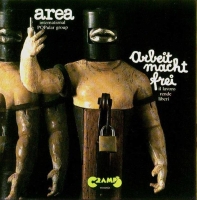
Area - Arbeit Macht FreI (1973)


One of the most talented and creative bands not only in the 70's italian progressive scene but in the prog rock history as well.Area deliver an excellent jazz rock album in their debut with some KING CRIMSON-like passages (just listen to the intro of ''Arbeit macht frei''),ethnic influences (the whole first track influenced by the arabian culture) and also some MAGMA-like sections (listen to the last track of the album).But it's not only the excellent musicianship that stands out,it's also the unique voice of Demetrio Stratos,one of the most obscure,powerful and weird voices I've ever heard.Stratos is the main figure of the band undoubtfully,I don't know if Area would have such a fame in the prog circles if Stratos weren't in the band...An album full of inspired vocal and music improvisations...5 stars and even more for jazz,RIO and Zeuhl lovers,

Songs / Tracks Listing

1. Luglio, Agosto, Settembre (Nero) (4:27) 
2. Arbeit Macht Frei (7:56) 
3. Consapevolezza (6:06) 
4. Le Labbra Del Tempo (6:00) 
5. 240 Chilometri Da Smirne (5:10) 
6. L'Abbattimento Dello Zeppelin (6:45)

Total Time: 36:24

Line-up / Musicians

- Demetrio Stratos / vocals, organ, still drums
- Patrick Djivas / bass 
- Patrizio Fariselli / pianos 
- Gianpaolo Tofani / guitars, VCS-3
- Giulio Capiozzo / drums, percussion
- Victor Edouard ('Eddie') Busnello / sax, bass clarinet, flutes

Monday, 1 April 2013

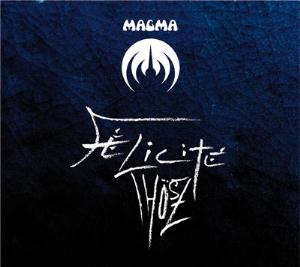
Magma - Felicite Thosz (2012)


On this (hopely till know) not too much anticipated 2012 release of one of the most original and progressive bands of progressive rock history we get to hear a different side of Christian Vander's composition skills. In stead of creating a dark operatic en technical album, Magma returns with an angelic celebration of life. For some this might sound risky, but we've also seen Magma showing it's feel-good adventerious moods on K.A. and it worked out fine. The 'Felicite Thosz' suite should be regarded as being a single 28 minute lasting composition, but is devided in small pieces on the cd. With a total of 32 minutes of running time this 'album' could almost be regarded as being an EP, but whilst listening to the album it really impresses as a full-grown album. 'Les hommes sont venu' is an extra four minute minimalistic piece with an emphasis on female vocals choir arrangements with a very mystical atmosphere.

The instrumentation on 'Felicite Thosz' reminds me a bit of the Wurdah Itah period; with piano, vocals and drums beging the main instruments. Of course the bass guitar also plays a significant role and some electric guitar lines were well integrated into the compositions. At first spin I'm delighted when it comes to the production, it has more depth and sounds less dense then E-R' and K.A. The vocals sound more authentic and therefor are a great contribution to the liveliness of the record. The drums of Vander, whom I think of as my favorite drummer (next to Jaki Leibezeit), impresses with subtle new findings and great accents during up-tempo parts. His way of writing compostions from a base of very effective and complicated rhythms is also effective in this relatively optimistic album. The strong forwarded pulses and swing (though not recognisable as such) really get's the whole thing running like a well oiled machine. And yes, every Magma fan knows that Magma is gerantied to give away some moments of maximum intesive playing and grotesque larger- then-life sounding musical landscapes.

Conclusion. Yet another must-have Magma release for fans an perhaps the easiest entry into the band's discography to this date. The production is great, the compostion briljant and the album has a really postive, mysterious & adventerious mood that really cheers me up. Perhaps fans of the dark type Zeuhl will be a bit dissapointed, but they should try this album anyway. I'm giving four stars right now, but perhaps the album will grow on me some more.

* Edited. This is a masterpiece and therefore fully deserves the five star rating in my opinion. Review from progarchives.com


Songs / Tracks Listing 

1. Félicité Thösz (28:06)

Ëkmah - 2:39
Ëlss - 1:11
Dzoï - 2:27
Nüms - 1:51
Tëha - 5:15
Waahrz - 4:03
Dühl - 1:19
Tsaï ! - 3:41
Öhst - 4:53
Zahrr - 0:49

2. Les hommes sont venus (4:18)

Total Time: 32:24


Line-up / Musicians

- Stella VANDER / vocals, tambourine
- Isabelle FEUILLEBOIS / vocals, bells
- Hervé AKNIN / vocals
- Benoît ALZIARY / vibraphone
- James MAC GAW / guitar
- Bruno RUDER / piano
- Philippe BUSSONNET / bass
- Christian VANDER / drums, vocals, piano, keyboard

LES HOMMES SONT VENUS

- Stella VANDER / vocals
- Isabelle FEUILLEBOIS / vocals
- Hervé AKNIN, Sandrine DESTEFANIS, Sylvie FISICHELLA, Marcus LINON / vocals
- Christian VANDER / keyboard, glockenspiel


Sunday, 4 November 2012

U Totem - U Totem (1990)


A Revelation.

Ever had one of those?

I had a few during my life; most occurred during dark, depressing or desperate times; others happened while listening to specific albums.

One such album was this one.

This revelation consists of the understanding that imagination and daring to explore are one of the great human traits; Understanding that music, at its most beautiful, whether complex or simple, can be a healer, a comforting friend, a motivator; Understanding that music can be a reason to live for, a purpose in life, a cause to get up in the morning and keep on living despite hardship.

Musicians from 5UU's and Motor Totemist Guild came together to create this masterpiece of an album and joined by other session musicians to complete the sound. I am having hard time expressing just how wonderful and special I find this album to be. It is one of those albums I feel a sort of catharsis while listening to it and want to start it over again when it ends. However, I feel un-equipped and not knowledgeable enough to write about this, but since I love this album so much, I'll give it a try and please forgive any mistake or nonsense I might write.

Instrumentation - Abundant and varied instrumentation makes this album a delight to listen to; so rich and smooth is the sound, along with Emily Hay's vocals. Saxophones, flute, piccolo, bassoon, contrabassoon, sitar, piano, vibraphone, guitar, bass, drums, percussion and the use of tape recordings - all those play the music, making it lively and special. Not only the type of music, the influences on composition, but the type of instruments are a look back at their influences which are I would guess 20 century composers (I am not an expert on this at all, but having read about and listened to some I would assume this is the case; Stravinsky would probably be one) and previous chamber rock groups.

The music has been said to be a mélange of 20th century classical music, avant-garde, rock, chamber music all mixed to an end result that is the special sound of U Totem. Well, yes but how to translate the greatness of this album into words? Complex, very well played, sophisticated and compelling, the music never ceases to amaze me. Just listen to "Both Your Houses" and how all the instruments combine together while the rhythm goes on. Not only shown by the complexity, the progressiveness of the music is shown also in how they ornament the songs with the instruments; in the intervals which are filled with the occasional "odd" sounds, atonal parts or "experiments"; they drift away with each song from the main theme to explore the grounds. Each song is cleverly orchestrated, maneuvered through the gushing waters, from one part where the classical instruments lead the way, into other parts, where the more "modern" rock instruments take over. With all this going about, the beauty is kept, the connecting musical thread is always there and the magic is never lost. The repetitive part in "Both Your Houses" around the fourth minute (before and after Emily screams her heart out in the background) is a fantastic example of how to play the same theme and make it sound great by changing the instruments and using whatever comes to mind (and using slightly different scales to create a seeming disharmony). Brilliant!

Take for instance "One Nail Draws Another" with its almost 15 minutes. It goes through so many different parts, uses so many elements of their influences, and yet there is not one boring moment, there is continuous movement, and constant progression while going back to visit the same themes as the song goes. Emily's vocals and the male opera-like vocals joining in the middle add to the richness already found in this song.

"Two Looks At One End" and Yellow Umbrella Gallery show their more modern influences, their avant-garde and quirky side (as if it wasn't enough as it is) and their use of the tape recordings and manipulation of the keyboards. Engaging and dynamic, weird and sometimes disharmonic, these pieces are enriched with the seemingly random use of the recorded sounds and voices and Emily's vocals (on that first track of the two).

Another thing to praise here is that each song is easily identifiable and different than the others. I don't sense a repetitiveness and yet the collection of songs and tracks fit very well together; each song brings its own approach (however slightly or not-so- slightly different than the others), making this collection of 7 songs feel as a whole - meaning, this feels like an album, and not like a collection put together.

This album might lead you to the US side of avant-rock/chamber-rock, if you haven't "visited" these realms already. Both the "donating" bands to U Totem are obvious bands to explore (although I much prefer this group or project), as well as Thinking Plague, whose In Extremis I think draws somewhat of an influence from this album.

To sum up, this is one of my all-time favourites. An album as rich in sound as it is special, complex, intriguing, thrilling, stimulating, exciting and whatever other adjectives you may want to add to it. Their sound mingling together music by 20th century composers, chamber rock and avant-garde is one that I treasure, and find beautiful, compelling. It was a revelation the first time I heard it; being struck by the combination of complexity, oddity and beauty, realizing how fantastic music can be when musicians take it to a ride through their wild imaginations and perform for us their vision.

Honestly, my words cannot do justice enough to this fabulous album and these fine musicians and composers. Reading this, I feel I have failed to pass on what goes through my mind when listening to this and more importantly what the music actually sounds like and how great it is. So I'll simply say that if you are a follower of this type of music, this is a must have album. If you are interested in checking this type of music, but don't yet feel comfortable enough in it or are new entirely, I would start elsewhere, and save this to later on when you can appreciate it fully and without trying to adjust to this type of music. It might take the pleasure of the album. But this is a mandatory stop station in your excursions throughout the avant-rock/chamber-rock (or whatever you want to call it) realm.

A must have!

Review from progarchives.com


Tuesday, 6 December 2011

Magma - Theusz Hamtaahk - Trilogie (2001)


Songs / Tracks Listing


1. Theusz Hamtaahk 1er mouvement : Theusz Hamtaahk (35:00)


1. Malaẁëlëkaahm

2. Sëẁolahẁëhn Öhn Zaïn

3. Diëümb Iëẁëlëss Dölëhn

4. Zeuhl Ẁortz

5. Gorutz Ẁaahrn'

6. Tü Lü Lï /ë Üi Dü Wïï

7. Sé Lah Maahrï Donsaï

8. Slibenli Dëh Theusz

9. Zortsüng


2. Theusz Hamtaahk 2er mouvement : Ẁurdah Ïtah (48:36)


1. Malaẁëlëkaahm

2. Bradïa Da Zimehn Iëgah

3. Manëh Fur Da Zëss

4. Fur Dïh Hël Kobaïa

5. Blüm Tendiwa

6. Ẁohldünt Miëm Dëẁëlëss

7. Ẁainsaht!!!

8. Ẁlasïk Steuhn Kobaïa

9. Sëhnntëht Dros Ẁurdah Süms

10. C'est la vie qui les a menés lá!

11. Ëk Sün Da Zëss

12. De Zeuhl Ündazïr


3. Theusz Hamtaahk 3er mouvement : Mëkanïk Dëstruktïẁ Kömmandöh (48:51)


1. Hortz Fur Dëhn Stekëhn Ẁest

2. Ïmah sürï Dondaï

3. Kobaïa Iss Dëh hündïn

4. Da Zeuhl Ẁortz Mëkanïk

5. Nebëhr Gudahtt

6. Mëkanïk Kömmandöh

7. Kreühn Köhrmahn Iss Dëh Hündïn

8. Da Zeuhl Ẁortz Ẁaïnsaht

9. Kobaïa


Total Time: 132:27
 
Line-up / Musicians


- Christian Vander / drums & vocals

- Klaus Basquiz / vocals & percussion

- Philippe Bussonnet / bass

- Benoit Widemann / keyboards

- Patrick Gauthier / keyboards

- Gabriel Federow / guitar

- Didier Lockwood / violin

- Stella Vander / vocals

Tuesday, 1 November 2011

Art Zoyd -Le Champ Des Larmes (2006)

Art Zoyd Le Champ Des Larmes album cover


Songs / Tracks Listing
1. Fleuve-Bruit 1 (3:38)
2. Tenebrae
(3:05)
3. Eclats de souffle (3:02)
4. Tam-Feu (2:26)
5.
Incendium / GC_Sub (3:17)
6. Fleuve de Pluie / Fleuve-Bruit 2 (6:51)
7.
Achéron _ le Fleuve Obscur (9:16)
8. Murmur Fulminis / Totem 1
(2:13)
9. Abundans Civitas (5:02)
10. Laetitia / Totem 2 (2:28)
11.
Sepulchra / Fleuve-Bruit 3 (3:33)
12. Styx _ le Fleuve Noir (18:32)
13.
Le chant de la Méduse (2:26)
14. Egressus / Totem 3 (6:26)

Total
Time: 72:14


Sunday, 18 September 2011

Art Zoyd - Le Mariage Du Ciel Et De L'infer (1985)

Art Zoyd Le Mariage Du Ciel Et De L'Enfer album coverIf I were in charge of organizing a ballet, one of the very last bands on the planet whom I would think of for scoring it would be Art Zoyd. Still, it's diversity that makes this world a better place. Roland Petit, who knows a hell of a lot more about ballet than me, did indeed do just that, immediately after seeing the Zoyd perform on television. As will probably be guessed by those already familiar with this band, the music may not always be 100% dark, but it can be counted on to be 99.9% uneasy. As this album demonstrates, the band is no less than masterful with subtle arranging and a penchant for building slow-burning tensions that might unceremoniously be pulled out from beneath the listener at a moment's notice.

The first composition, "Sortie 134 - Part 1" is a classic representation of what the band is all about, displaying a strong Bartok and Stravinsky influence and also musique concrete elements (e.g., the sampled children's laughter). The climax features Zaboïtzeff's doomed vocals getting drowned in a sea of organ lurches, piano stabs, chiming clock noises, and a 1-2 percussive pounding.

If you think the polyrhythmic activity of King Crimson's "Thrak" was challenging, then sink your flimsy teeth into "Cryogenèse - Rêve Artificiel." Two particular sections come to mind. One is right at the beginning, with accented notes against a (required...believe me) metronome ticking away. Seventeen beats in, the first accented note occurs. This is followed 10 beats later by a double-accent, then a single accent 9 beats after that, and a double accent in-between the 9th and 10th beat after that, before the cycle repeats. Then there's the section that begins at 4:56. Here the metronome clicks off a 31-beat cycle, with accents on the 1st, 3rd, 6th, 12th, 16th, 21st, and 24th beats. After one of their trademark lengthy, dynamic buildups with triplicate polyrhythms and sinister organ chordal washes, the music suddenly gets flushed and the 31-beat pattern played over with a five-beat lag, before everything is eventually overtaken by various animal sounds, lawnmower-like drones, and asthmatic breathing. See why I wouldn't think of this band to score a ballet?

For the most part, the "Io" and "Mouvance" pieces constrain themselves to one theme with a firm use of repetition; thus, they are more immediately accessible. Out of these, I am particularly taken with "Io 1," a simple utilization of the Leading Whole Tone scale (C-D-E-F#-G#-A#-B-C), combined with other-worldly trumpet from Soarez. If Miles Davis had sat in with Univers Zero, this undoubtedly would be what the resulting music would sound like. The brisk rippling of keyboard notes on "Mouvance 2" are effectively contrasted by the neurotic staccatos that open up "Mouvance 1."

After these short pieces forming the middle of the album, "Cryogenèse" (the return of the dreaded metronome!) gets magnificently revisited, by its end overloading the listener with a pure sense of dread. The album closes with a coda ("Sortie 134 - Part 2"). Not awful by any means, but with its drum machine and jarring, techno feel, it represents the least of the moments on this disc.

Overall, though, the music on Le Mariage du Ciel et de L'Enfer is terrific and ranks among Art Zoyd's best work. Texturally, it is an optimal balance between their increasing incorporation of electronic timbres in the 1980s with their earlier, more organic period. The music also balances their level of compositional sophistication that easily holds its own with contemporary classical music, while at the same time being reasonably digestible for new listeners. This album represents an excellent inroad for those interested in exploring Art Zoyd's output. I don't know how the ballet was received, but from the picture shot included in the CD, it looks pretty wild and I would have loved to have seen it. Incidentally, Petit also hired another prog-related band in the early 70s to compose and perform one of his ballets (hint: their name ended in "-oyd," too). Ground and Sky review - Art Zoyd - Le Mariage du Ciel et de L'Enfer

This was released as a double album back in 1985 and was the music for Roland Petit's ballet called "The Marriage Of Heaven And Hell".It's hard to believe this was used as music for a ballet,although Petit was known for his theatrical productions.He apparently saw ART ZOYD on television and so contacted them about doing this.I must say i feel very fortunate to have this cd as it is the last of their chamber music period before they went heavily into electronics.This is the only one of their early period that is not out of print yet,and it's one of their best.I got my copy at "Wayside Music".What's it sound like ? Well my favourite place to listen to music is in my truck on my hour drive to and from work. I listen to the longer cds like this on my way home because i can take my time and go the long way.I've been listening to this all week at work and one customer gave me a hard time about it saying i should have Christmas music on instead of this depressing stuff,i decided to let him live.So tonight on the way home in the dark i had a careful listen to this recording.The closest reference in my opinion is UNIVERS ZERO,in that this is very intense and dark.This is more minimilstic and experimental but every bit as good,in fact i like it better than UNIVERS ZERO's early works. "Sortie 134(Part 1)" opens with a lot of tension as dual piano melodies and trumpet lead the way before it calms down and we can hear children laughing.Some violin and piano before a full sound comes back 3 minutes in that comes and goes.A change before 6 minutes as we get lots of percussion and piano.Vocal melodies before 8 minutes.This is intense!Great track ! It ends with children laughing again as it blends into "Cryogenese(Reve Artificiel)".The sound of a metronome ticking can be heard as trumpet blasts and piano comes in.A change 3 minutes in as the metronome stops and the trumpet and piano continue.Again this is so intense.Another change 5 minutes in as metronome returns with piano.I'm reminded of UNIVERS ZERO 6 1/2 minutes in.Trumpet a minute later.Actually an outbreak of trumpet 9 1/2 minutes in goes on for a minute.It becomes so intense and unrelenting.Another change 14 1/2 minutes in as some strange sounds replace the trumpet.Sounds like synths 16 1/2 minutes in as the piano stops.What a ride that was. "Io 1" features sax melodies that are at time dissonant. "Io 2" is eerie and haunting.A cool rhythm with sax comes in that stops and starts.I like this one. "Io 3" opens with almost a pulsating sound as violin comes in.It stops and then continues but this time piano is added.It stops again and restarts.This part is kind of spooky.Vocal melodies join 4 minutes in. "Mouvance 2" incorporates these wonderful piano melodies.A full sound before 3 minutes. "Mouvance 1" features more piano but it's more aggressive.Trumpet comes in tastefully as we again have two pianos being played.The intensity is removed as the song settles down.Violin comes in as piano quietly plays on. "Cryogenese(Les Portes Du Futur)" opens with outbursts of piano.Percussion comes and goes.Organ and trumpet 1 1/2 minutes in.The outbreaks come back.Violin 3 1/2 minutes in.Vocal sounds.Metronome comes in.Organ 7 minutes in.The rest of the song is fantastic ! One of the best part of the album.It has more of a melody with trumpet blasts,piano and organ. "Sortie 134(Part 2)" has a good beat, and the children laughing are back.Vocal melodies and speaking as well.Great ending to this album. When i finished listening to this i thought to myself "Was that just a bad dream i had ?" ART ZOYD have just been put near the top of my favourite Rio-prog band list.Get this record !! ART ZOYD Le Mariage Du Ciel Et De L'Enfer music reviews and MP3


Songs / Tracks Listing
1. Sortie 134 - Part 1 (11:00)
2. Cryogenèse - Rêve Artificiel (18:12)
3. IO 1 (3:51)
4. IO 2 (2:15)
5. IO 3 (5:15)
6. Mouvance 2 (3:34)
7. Mouvance 1 (5:54)
8. Cryogenèse - Les Portes du Futur (14:30)
9. Sortie 134 - Part 2 (3:48)

Total Time: 68:19
Line-up / Musicians - Patricia Dallio / electric piano, grand piano, keyboards
- Gérard Hourbette / viola, violin, electric piano, grand piano, keyboards, percussion
- Jean-Pierre Soarez / trumpet, percussion
- Thierry Zaboitzeff / cello, bass guitar, voices, tapes, keyboards, percussion
- Didier Pietton / Soprano saxophone


Art Zoyd - Sortie 134 - Part 2


Download Mp3

Monday, 5 September 2011

Zaboitzeff & Crew - Voyage au centre de la Terre (2010)


Another outstanding concept album translating as 'Journey To The Center of the Earth', this is no Rick Wakeman though!

 Highly sampled music as ever and complexeties abound in this musicians extreme forays into experimental contemporary electronic imagary.


Thierry Zaboitzeff & Crew (ex art zoyd) Laudemus Virginem ( Llibre Vermell extract )


Download Mp3

Thursday, 28 July 2011

Univers Zero - 1313 (1977)


Back in the days when a prog fan had to seek out their fare, struggling to find those little prizes, the endless quest, personal and financial sacrifice and constant scorn from a Steve Miller and Carpenters-loving world, Univers Zero was no joke. Startling, brave and years ahead of their time, percussionist Daniel Denis led a chamber septet that rocked, or a rock band that liked to play parlour music... or both, and its history is crucial to the development of European progressive and avant garde music. Their roots began in 1970 with Arkham, the black and brooding Brussels group who traced their inspirations to the Canterbury school in England, particularly Soft Machine and its minimal jazz-rock adventures. Arkham's final concert took place in 1972 and its members went on to play with such legendary acts as Magma, Aksak Maboul, and Pazop. Daniel Denis formed Necronomicon (not the German band) with Claude Deron, finally emerging as Univers Zero in 1974. By 1977 he had some very good help from guitarist Roger Trigaux, bassoon player Michel Berckmans, violinists Marcel Dufrane and Patrick Hanappier, bassist Christian Genet and harmonium player Emmanuel Nicaise. This line-up would produce a music so new and disturbing that it would set the tone for much of the Rock In Opposition that came after, an influence that is deeply felt even today.

On their debut '1313', an unnerving violin and its bassoon counterpart sputter to life, followed by a twisted lot of various strings and trashed drums sounding like a makeshift set of kitchen utensils for the 14-minute 'Ronde', off-putting, squeaky and fantastically progressive. Daniel Denis and friends clearly wanted something more-- to split music apart, bring it back together and revel in the pain of that process. And though the pieces are entirely acoustic chamber music played with precision, the Zeroes did it with a rock spirit no less bare-knuckled than any of their contemporaries. 'Carabosse' murmurs with psychotic tendencies, and 'Docteur Petiot' has the band letting go with inspired darkness, nightmarish delirium, broken toys, and shades of Bartok and fellow Belgian composer Albert Huybrechts. 'Malaise' plays out like a drug withdrawl and 'Complainte' rusts its way out of this troubled record, and us with it.

Progressive Rock in the truest sense, doom music for grown-ups, every fan should have some Univers Zero around... you have to. It's the law UNIVERS ZERO Univers Zero (1313) music reviews and MP3 Review from progarchives.com

Songs / Tracks Listing 1. Ronde (15:08)
2. Carabosse (3:40)
3. Docteur Petiot (7:32)
4. Malaise (7:32)
5. Complainte (3:18)

Total Time: 36:50

Line-up / Musicians
- Michel Berckmans / bassoon
- Daniel Denis / percussion
- Marcel Dufrane / violin
- Christian Genet / bass
- Patrick Hanappier / violin, viola, pocket cello
- Emmanuel Nicaise / harmonium, spinet
- Roger Trigaux / guitaLine-up / Musicians


Sunday, 13 March 2011

Art Zoyd - Nosferatu (1989)


This is the first of three soundtracks ART ZOYD did for those silent horror movies of the twenties.This one is for F.W. Murnau's 1922 released movie called "Nosferatu" which was based on Bram Stoker's book called "Dracula".Interesting that Stoker's widow sued Murnau for copyright infringement and won.All copies of his movie were destroyed although bootleg copies survived.The lineup on this album is the same as on the previous one "Berlin".I have to say off the top that this surpassed my expectations by a wide margin.This is incredible! In fact i'd like to quote some of Kai Karmanheimo's thoughts because he says it so perfectly: "Dissonance is prolific,tonality itself unstable and hummability lies dead in it's coffin,but instead of chaotic and cacophonous,the music comes across as rigorously regimented and ruthlessly repetitive,with individual instrumental links subjugated and blurring together to create a singularly sinister impression". He goes on to say : "...it's the choice of timbres,the sizzle of sinister electronics,that sustain the music through minimilist episodes and obsessive repetition and makes "Nosferatu" more interesting in my ears than ART ZOYD's earlier,predominantly acoustic works that i have heard".So we get 17 tracks at almost 53 minutes and three bonus tracks from a ballet called "Vornange" they did a year earlier.Those three tracks give us over 17 minutes of excellent bonus material.Hourbette composed 8 of the tracks on "Nosferatu" with Zaboitzeff composing the other 9 songs. "L'oef Du Serpent" opens with a dark atmosphere and percussion before this almost buzzing sound comes in.This is a powerful soundscape that will make you restless. "L'agent Renfield" is also dark and haunting before it calms right down.Strings before 2 minutes as it turns dark and creepy.Sounds like a beast is on the prowl.I don't think his name is Edward either.A calm with piano ends it as the danger has passed. "Le Voyage De Harker" is eerie with outbursts that are alarming to say the least.We start to get a rhythm that sounds like the train to hell.It's like your too afraid to move but you can't stay where you are.This is freaking scary! Chimes on the next short track before we get to the wind blowing(it's like there's voices in the wind or is that my imagination) on "Le Chateau" with loud sounds coming and going.Then we hear the birds chirping 2 minutes in with flute,bass and strings to follow.Morning has come and the danger has again passed for now. 'Nosferatu" has these striking abrasive sounds with strings.This is all very disturbing. "L'oeuf Du Serpent II" is what i'm sure fear sounds like. "Rumeurs" opens with percussion and other unpleasant sounds,then that wind starts blowing again with those voices crying out in horror.Or is that my mind playing tricks again. "Rumeurs II" has lots of atmosphere and it's not enjoyable. Pulsating sounds on "Anaphase" and other creepy sounds that will make your hair stand up before "Le Maitre Arrive" takes over.Cold piano lines and vocal melodies early before it changes to a fuller and richer sound.Back to the keys and vocal melodies to end it. "Rumeurs III" has these deep throaty spoken words part way through before we get a children's choir with keys then sax."Les Docteurs" is almost catchy with that slow rhythm. Samples of a woman talking and birds chirping on "La Peste". "Livre Des Vampires" is scary."Anaphase II" is darker with percussion and sax.Powerful. "Le Maitre Vit Mort" is dramatic yet melancholic.Then flurries of piano with weird vocal samples take over. I'll be breaking this out on halloween this year.I still think "Berlin" is better but man this is impressive. ART ZOYD Nosferatu music reviews and MP3 (Review from progarchives.com)

Songs / Tracks Listing

1. L'oeuf du serpent (3:40)
2. L'agent Renfield (3:17)
3. Le voyage de Harker (4:03)
4.Le matin (1:40)
5. Le château (4:14)
6. Nosferatu (2:42)
7. L'oeuf du serpent II (3:00)
8. Rumeurs (2:35)
9. Rumeurs II (2:56)
10. Anaphase (4:08)
11. Le maitre arrive (2:24)
12. Rumeurs III (2:39)
13. Les docteurs (2:28)
14. La peste (3:14)
15. Livre des vampires (1:47)
16. Anaphase II (4:38)
17. Le maitre est mort (3:23)

Total Time: 52:48
Line-up / Musicians
- Patricia Dallio / pianos, keyboards
- Gérard Hourbette / viola, violin, pianos, keyboards, percussion
- André Mergenthaler / cello, alto sax, bass vocals
- Thierry Zaboitzeff / cello, bass guitar, vocals, tapes, keyboards, percussion


Tuesday, 8 March 2011

Peter Frohmader - Nekropolis Live '79 (1997)


The Awakening - Nekropolis live '79 has been recorded in Munich, Germany 1979. According to the official release dates of PETER FROHMADER's albums, this live has been recorded before the subsequent NEKROPOLIS studio albums. Also, the track titles in this album do not match with any of the track titles that appear in the studio releases, so I will assume that these are compositions recorded for the first time (?).

I can not recall how this album came to my collection but I have not paid attention to it for years. I am also not familiar with PETER FROHMADER's career but he seems to be a very interesting case of composer. Personally, I feel the tag progressive electronic does not entirely represent the music in this live (?) recording. I have to assume (again) that by LIVE, the composer means ''played live in studio'', as there is no sign of the existence of an audience throughout the 75 mins that this albums lasts.

The music in the album matches perfectly with the title NEKROPOLIS. In The Awakening, FROHMAEDER's band presents a dark, eclectic set of compositions. Contrary to the electronic and krautrock elements, the main influences in the album's sound come from different areas of progressive music (in general): strong jazz and fusion passages, eclectic use of instruments and rhythms and even elements from zeuhl. The band's rhythm section is the one that stands out and generally provides a solid background for the fair amounts of jamming and improvisation taking place in almost all compositions. Its other function is to create interesting tribal rhythms in several moments in the album.

Friends of progressive electronic will realise the krautrock background in tracks like Escape from Hell. Special mention needs to go to the bizarre instruments used in this album, which bring a strong touch of oriental and African music. Flutes, clarinets and gongs are used in a way to reflect the album's cover (i.e. Egypt, pyramids, pharaohs). As mentioned, jazz/fusion is dominant (Kadu, Jazz-trap) but the main thing that come in my mind when hearing this album is KING CRIMSON. I am not sure if FROHMADER is a fan of the band, but this whole dark and obscure musical approach heavily resembles to the eclectic prog created by KC.

Some compositions are quite long and include lots of improvisation that might bore the listener in certain moments. The overall length of the album is also an issue, with the music being almost constantly complex and ''difficult to comprehend''. However, this feature makes ''The Awakening'' a highly challenging piece of music that will find its admirers in progressive music. Although it is not exactly ''my cup of tea'', I think that jazz/fusion, krautrock and eclectic prog fans will find lots of interesting elements here...PETER FROHMADER The Awakening - Nekropolis Live '79 music reviews and MP3 (Review from progarchives.com)

Songs / Tracks Listing 1. The Awakening Part 1 (8:46)
2. The Machine (7:20)
3. Escape From Hell (6:33)
4. Cult [Trio-Version] (12:44)
5. Kadu (8:07)
6. Neutron [Trio-Version] (4:39)
7. Jazz Trap (12:21)
8. The Awakening Part 2 (14:35)

Total Time 75:08

Line-up / Musicians -
 Peter Frohmader / bass, fretless, 8-string bass, electronics, gongs, kalimba, voice
- Peter Becker / guitar, voice
- Martin Stopper / drums, kalimba
- "Spix" / bass clarinet, german flute
- Werner Aldinger / trombone


Peter Frohmader - Nekropolis

Download mp3

Saturday, 26 February 2011

Weidorje - weidorje ( 1978 )

Weidorje's self-titled and only EP (now consisting of two live tracks, on the Musea CD reissue), released in 1978, is certainly a treat for Magma fans. Especially those who like Bernard Paganotti's bass playing and the Üdü Wüdü" (Jannick Top & Paganotti on bass) sound. Unlike many listeners and fans of Zeuhl music, I came across Weirdorje before Magma. However, I believe this album is much easier on the ears than some Magma albums, so it was indeed a good choice for me to begin my Zeuhl journey. The music is mostly instrumental and the voices that are present (supplied by Bernard Paganotti and Yvon Guillard) is mainly scat, so it leaves my ears free to listen to the wonderful music being played. The really exciting factor about Zeuhl is the fuzz-bass. Bernard Paganotti is a master of the style (along with Jannick Top and non-Zeuhl musician Hugh Hopper), so naturally when I first heard this album, I was immediately struck by the thumping bass. Of course, there is more to Weidorje than just the fuzz-bass, because another former Magma personality is present on this album in the name of Patrick Gauthier. He and Jean-Philippe Goude (both on keyboards) add some very dark and gloomy polyrhythmic sounds which add superb atmosphere and rhythm, as does Michel Ettori on guitar who plays along with Paganotti's bass lines in many places.

The opening track, Elohim's Voyage starts off, as one would suspect, with a crunching bass sound but soon Gauthier's keyboard adds a chilling touch. The main rhythmic charge then begins, with the aforementioned scat vocals, the slowly increasing heavier drumming and then the guitar. This assault continues on throughout the 16 minutes but with added surprises, such as Alain Guillard's avant-garde saxophone. Approaching the halfway mark, the band are in full flow and then everything slows down once more yet the track keeps together solidly. With four minutes to go, the tune reprises with trumpet and saxophone accompaniment. This reflects classic Magma but feels darker and more disturbing, and is a strong track to start precedings. Vilna is the strongest track of the album, beginning with a catchy keyboard riff that leads on until Paganotti's bass. Vilna is not as heavy as Elohim's Voyage, yet is just as catchy (if not more so), continuing on in true Zeuhl-style with a relentlessness of rhythmic sound. This is another difficult track to describe, so I shall leave it for the listener. Originally, the album would have finished with Booldemug, a softer track that reminds sometimes of Third era Soft Machine (though Hugh Hopper's bass never got this fuzzy!). This is jazzier than the previous tracks - bordering on jazz rock/fusion - featuring much more saxophone and guitar and is a welcome break from what has gone before, making the band sound more diverse than one would initially expect. It is also here that you realise how much the keyboards dominate Weidorje's sound without overwhelming the rest. Ettori also unleashes his guitar skills here, so listen out, as his playing is exceptional. As previously stated, French label Musea released Weidorje in 1992 with bonus tracks. Unfortunately the cuts here are aurally inferior to the studio ones heard previously. Thankfully, the music is just as great and proves they could perform live as well. Rondeau sounds ethnic and medieval in places, dominated by the keyboards. Due to the sound quality, the bass is not so strong in the mix but doesn't lessen the charm of this cut. Expect the same kind of catchiness as previous tracks just more sedated and laid-back, and listen out halfway through as there is some rather nice jazzy moments thanks to the trumpet and guitar. A studio version of this selection would have sounded marvelous, so it is a shame they never released another album. Kolinda mostly consists of an astounding bass solo by Bernard Paganotti. The track starts off with yet more memorable rhythms and when the solo begins, it often reminds quite a bit of the late Berry Oakley, Jr.'s (Allman Brothers' Band) playing style which when I first heard it, came as a very pleasant surprise.

Despite their use of catchy rhythms, Weidorje never get dull or boring, continuously and subtly changing things. The changes are often so subtle, you do not notice them. I have listened to the album many times and I always forget there is a trumpet and saxophone used as they are used scarcely, yet without them, the tracks would sound completely different. I have given this album a 5/5 (4.8) rating, even with the poorly recorded bonus tracks, because an album of this quality does not come about very often. This is a gem of a record and is still an essential release for those who have discovered Magma, or who want to discover Magma in the future and a great introductory level album if not always the easiest of listens. WEIDORJE Weidorje music reviews and MP3 (Review from Progarchives.com)

Songs / Tracks Listing
1. Elohim's Voyage (16:31)
2. Vilna (12:19)
3. Booldemug (7:10)
Bonus tracks:
4. Rondeau (live) (8:48)
5. Kolinda (live) (12:27)

Total Time: 57:15
Line-up / Musicians
- Bernard Paganotti / bass, vocals
- Patrick Gauthier / keyboards
- Michel Ettori / guitar
- Kirt Rust / drums
- Alain Guillard / saxophone
- Yvon Guillard / trumpet, vocals
- Jean-Phillipe Goude / keyboards


Weidorje - Vilna


Weidorje


Nor


WEIDORJE - Chorus Antenne 2 - 1979

Download mp3

Tuesday, 22 February 2011

Present - High Infidelity (2001)


This fifth studio album (the third since their reformation) sees Present progress yet some more in the complex RIO and Zeuhl world, that they are building with every album of theirs. The groups is now in an extended form with with a sring and brass section, but is most are presented as full members, the main quartet of Trigaux (father and son), Chevalier and drummer Dave Kerman is still the heart and soul of the band. Macksoud , the bassist is a regular with band today. A rather bizarre sombre almost underground artwork (a collage of Israeli or Palestinian streets night scene) certainly sets the sombre mood of the album, but the album is not really any darker than the previous ones.

From the opening six-parts suite Soul For Sale (27 min+) with its insane and oppressive groove on which both father and son pull some searing guitar lines that even Fripp would love to have written, is constantly shifting and twisting almost uncontrollably sometimes reminding you Magma. The brass section adds more than a bit of variety in the soloing, and certainly is used for full drama as underlining the constant tension.

The two-parts 11 minutes Strychnine For Christmas (under-titled The Truth About Santa Claus) penned by Pierre Chevalier, is softly underscored by a rare Mellotron behind a rather distant Crimson influence, but the vocals are certainly perfectible (English lyrics and vocals from Kerman). Third and last track, written by Trigaux, is the Rêve De Fer (Iron dream) , but it has not metallic intention, but finishes as a tribute to a well known theme (get the album to unveil the suspense ;-) with Belew-Fripp interplay.

Yet another stunning work (if a little repetitive) from the Trigaux gang, this album has been released ion the small Belgian Carbon 7 label (who handles also Aka Moon), and it is one of the better moments in Present's career. The group has for manager ex-bassist Guy Segers, now. Not groundbreaking anymore, this is yet another typical Present album, even if they keep on progressing musically. ( review from progarchives.com )

Songs / Tracks Listing

1. Souls For Sale (1) 3:16
2. Souls For Sale (2) 3:26
3. Souls For Sale (3) 3:41
4. Souls For Sale (4) 5:29
5. Souls For Sale (5) 4:57
6. Souls For Sale (6) 6:47
7. Strychnine For Christmas (1) 3:57
8. Strychnine For Christmas (2) 7:00
9. Reve De Fer 9:23

Total Time: 47:56


Line-up / Musicians

- Roger Trigaux / guitar, vocal
- Reginald Trigaux / guitar, vocal
- Pierre Chevalier / piano, keyboards, organ, mellotron, vocal
- Dave Kerman / drums, percussion, vocal
- Keith Macksoud / bass
- Matthieu Safatly / cello, vocal
- Fred Becker / alto & tenor sax
- Dominic Ntoumos / trumpet, flugelhorn
- Udi Koomran / sound

Guest musicians:
- Yuval Mesner / cello
- Meidad Zaharia / accordion


Present - Strychnine For Christmas

Thinglink Plugin

ThingLink